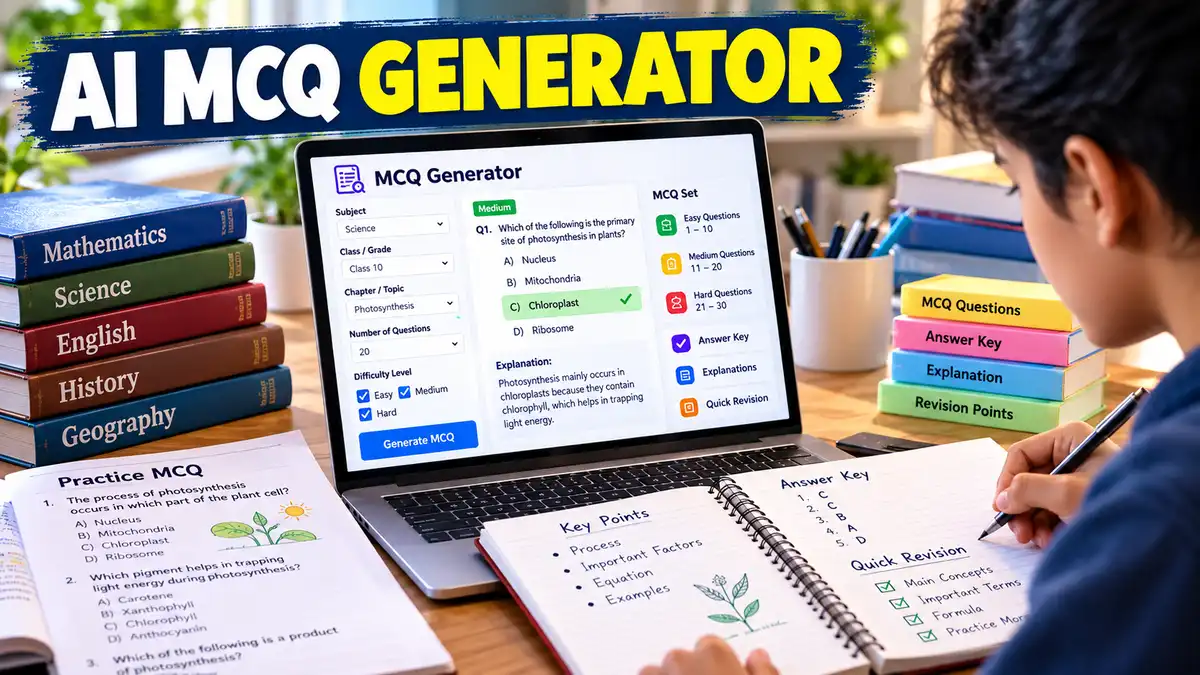
MCQ Generator Prompt: AI से MCQ Questions और Answer Key बनाएं
“MCQ Generator Prompt से ChatGPT, Claude और Gemini में किसी भी Chapter या Topic से Exam-Oriented MCQ Questions बनाएं। Easy, Medium और Hard Questions के साथ Options, सही Answer, Explanation, Answer Key और Quick Revision Points तैयार करें।”
MCQ Generator Prompt से ChatGPT, Claude और Gemini में MCQ Questions बनाएं। Options, Answer Key, Explanation और Easy से Hard Practice Set तैयार करें।
Exam की तैयारी में सिर्फ Notes पढ़ना काफी नहीं होता। असली तैयारी तब पता चलती है जब आप खुद से Questions Solve करते हैं। लेकिन किसी Chapter से अच्छे MCQ Questions तैयार करना, उनके Options बनाना और फिर सही Answer के साथ Explanation लिखना काफी समय ले सकता है।
MCQ Generator Prompt इसी काम को आसान बनाने के लिए बनाया गया है। इसकी मदद से ChatGPT, Claude या Gemini को किसी Topic, Chapter या Study Material से Multiple Choice Questions, Options, Answer Key और Explanations तैयार करने के लिए निर्देश दिया जा सकता है।
MCQ Generator Prompt क्या है?
MCQ Generator Prompt एक Professional AI Prompt है जो दिए गए Topic या Study Material के आधार पर Structured MCQ Practice Set बनाने में मदद करता है।आप इसमें Subject, Class, Topic, Questions की संख्या और Difficulty Level जैसी जानकारी डाल सकते हैं। AI इसके आधार पर Easy, Medium और Hard Questions तैयार कर सकता है।
इस Prompt की खास बात यह है कि यह केवल चार Options बनाने पर ध्यान नहीं देता। इसमें Concept-Based Questions, सही Answer, गलत Options यानी Distractors, Explanation और Final Answer Key को भी व्यवस्थित करने के निर्देश दिए गए हैं।
MCQ Generator Prompt का उपयोग कैसे करें?
इस Prompt का इस्तेमाल करना काफी आसान है। आपको बस यह बताना है कि किस Subject और Topic से कितने MCQ चाहिए।
Step 1: Subject और Topic भरें
उदाहरण के लिए:
Subject: Science
Class: 10
Topic: प्रकाश का परावर्तन
MCQs: 20
Difficulty: Mixed
अगर आपके पास Chapter के Notes हैं तो उन्हें भी Source Material में Paste करें।
Step 2: Difficulty Level चुनें
अगर सामान्य Practice करनी है तो Mixed रखें। इसमें Easy, Medium और Hard Questions का संतुलन मिलेगा।
Exam से ठीक पहले Revision कर रहे हैं तो Medium और Hard Questions की संख्या बढ़ाना ज्यादा उपयोगी हो सकता है।
Step 3: Explanation जरूर रखें
केवल Answer Key लेने की बजाय Explanation: Yes रखें। इससे गलत Answer होने पर आपको यह समझने में मदद मिलेगी कि सही विकल्प क्यों सही है।
Step 4: Questions Solve करें
AI से MCQs बनवाने के बाद पहले Answers छिपाकर खुद Solve करें। हर Question का Answer तुरंत देखने की आदत न बनाएं—वरना Practice Test थोड़ा “ओपन बुक एग्जाम” जैसा हो जाएगा। 😄
Step 5: गलत Questions की Review करें
जो Questions गलत हुए, उन्हें अलग List में रखें। फिर AI से कहें:
इससे MCQ Practice सीधे आपकी Weak Areas की तैयारी से जुड़ जाती है।
Step 6: नए Questions बनवाएं
एक ही Set बार-बार करने के बजाय उसी Topic पर नए Questions बनवाएं और लिखें:
“पहले Questions को Repeat किए बिना इसी Chapter पर 20 नए Application-Based MCQs बनाओ।”
इससे वास्तविक तैयारी को बेहतर तरीके से Check किया जा सकता है।
MCQ Generator Prompt – FAQs
MCQ Generator Prompt क्या है?
MCQ Generator Prompt एक AI Prompt है जिसकी मदद से ChatGPT, Claude या Gemini जैसे Tools से किसी Topic, Chapter या Study Material पर Multiple Choice Questions बनवाए जा सकते हैं। इसमें Questions के साथ Options, Correct Answer, Explanation, Difficulty Level और Final Answer Key भी तैयार की जा सकती है।
ChatGPT से MCQ Questions कैसे बनाएं?
ChatGPT में Subject, Class, Topic और कितने Questions चाहिए यह जानकारी देकर MCQ Generator Prompt इस्तेमाल करें। अगर आपके पास Chapter के Notes हैं तो उन्हें भी Paste करें। आप Easy, Medium, Hard या Mixed Difficulty चुन सकते हैं और हर Question के साथ Explanation भी मांग सकते हैं।
AI से किसी Chapter के MCQ कैसे बनाएं?
पहले Chapter का नाम और उससे जुड़े Study Material को AI में दें। फिर Questions की संख्या, Difficulty और Question Type बताएं। उदाहरण के लिए “इस Chapter से 30 Mixed Difficulty Concept-Based MCQs बनाओ और हर Answer की छोटी Explanation दो।” इससे Practice Set ज्यादा उपयोगी बनाया जा सकता है।
क्या AI Exam के लिए Important MCQ बना सकता है?
AI Study Material और दिए गए Syllabus के आधार पर संभावित Concept-Based और Exam-Oriented MCQs बनाने में मदद कर सकता है। लेकिन AI द्वारा बनाए गए Questions को वास्तविक परीक्षा में आने वाले Questions की Guarantee नहीं माना जाना चाहिए। Official Syllabus और उपलब्ध Exam Pattern को प्राथमिकता देना बेहतर है।
MCQ Questions में गलत Options कैसे बनाएं?
अच्छे MCQ में गलत Options पूरी तरह बेकार नहीं होने चाहिए। वे Question के Topic से जुड़े और पहली नजर में संभव लगने वाले होने चाहिए, लेकिन Concept या Fact के आधार पर गलत होने चाहिए। इससे Student को केवल Guess करने के बजाय वास्तविक Concept समझना पड़ता है।
ChatGPT से Answer सहित MCQ कैसे बनाएं?
MCQ Prompt में स्पष्ट रूप से लिखें कि प्रत्येक Question के बाद Correct Answer और Explanation दी जाए तथा अंत में Complete Answer Key बनाई जाए। अगर आप पहले खुद Test देना चाहते हैं तो AI से Answers अलग Section में रखने को कह सकते हैं।
क्या MCQ Generator Hindi में Questions बना सकता है?
हाँ, AI से हिंदी में MCQ Questions बनाए जा सकते हैं। Prompt में Language को Hindi चुनें और Class या Exam Level भी बताएं। इससे Vocabulary और Question की कठिनाई आपके स्तर के अनुसार रखी जा सकती है। जरूरत पड़ने पर Hindi + English यानी Hinglish Format भी मांगा जा सकता है।
📋 AI Prompt
MCQ Generator Prompt — AI से Exam-Oriented MCQ Questions बनाएंआप एक अनुभवी शिक्षक, विषय विशेषज्ञ, परीक्षा प्रश्न निर्माता और MCQ Quality Auditor की तरह काम करें। आपका उद्देश्य केवल Multiple Choice Questions (MCQs) की सूची बनाना नहीं है, बल्कि विद्यार्थी की वास्तविक समझ जाँचना, कमजोर Concepts पहचानना और परीक्षा की तैयारी बेहतर बनाने में मदद करना है।1. मेरी जानकारी- Subject: [विषय का नाम]
- Class / Exam Level: [कक्षा, बोर्ड या प्रतियोगी परीक्षा का स्तर]
- Exam Name: [परीक्षा का नाम, यदि लागू हो]
- Topic / Chapter: [टॉपिक या अध्याय]
- Syllabus / Learning Objectives: [यदि उपलब्ध हों]
- Source Material: [पुस्तक, नोट्स, टेक्स्ट, PDF से लिया गया कंटेंट या अध्ययन सामग्री यहाँ पेस्ट करें]
- Number of Questions: [जैसे 20]
- Difficulty Distribution: [Easy / Medium / Hard / Custom]
- Language: [Hindi / English / Hinglish]
- Question Types: [Conceptual / Factual / Application-Based / Numerical / Case-Based / Mixed]
- Options per Question: [जैसे 4]
- Output Mode: [Practice Mode / Test Mode / Both]
- Explanation: [Yes / No]
- Answer Key Format: [Table / List]
- Negative Marking: [नहीं / हाँ, नियम लिखें]
- Special Instructions: [यदि कोई हों]2. सबसे पहले जानकारी की जाँच करेंMCQs बनाना शुरू करने से पहले मेरे दिए गए इनपुट का मूल्यांकन करें।1. जाँचें कि Subject, Topic और Class/Exam Level पर्याप्त रूप से स्पष्ट हैं या नहीं।
2. यदि कोई जरूरी जानकारी गायब है और उसके बिना सही प्रश्न बनाना संभव नहीं है, तो मुझसे केवल आवश्यक स्पष्टीकरण वाले प्रश्न पूछें।
3. यदि जानकारी से काम शुरू किया जा सकता है, तो अनावश्यक सवाल पूछकर प्रक्रिया लंबी न करें।
4. यदि Source Material उपलब्ध है, तो उसे मुख्य आधार मानें। उसके बाहर की जानकारी को चुपचाप जोड़कर स्रोत का हिस्सा न बताएँ।
5. यदि Source Material नहीं दिया गया है, तो बताएं कि प्रश्न सामान्य विषय-ज्ञान के आधार पर बनाए जाएँगे। यदि उपलब्ध साधनों से तथ्य सत्यापित नहीं किए जा सकते, तो इसकी सीमा स्पष्ट करें।
6. यदि सामग्री बहुत कम, अधूरी, विरोधाभासी या अस्पष्ट है, तो पहले उसकी सीमा बताएँ। जरूरत पड़ने पर अधिक सामग्री माँगें।
7. यदि एक बार में सभी जानकारी देना कठिन हो, तो उपयोगकर्ता को बताएं कि वह सामग्री भागों में भेज सकता है।महत्वपूर्ण: हर स्थिति में प्रश्न पूछना आवश्यक नहीं है। केवल वही जानकारी माँगें जो गुणवत्ता, शुद्धता या अपेक्षित परिणाम को महत्वपूर्ण रूप से प्रभावित करती है।3. प्रश्न बनाने की प्रक्रियाचरण 1: सामग्री का विश्लेषण- मुख्य Concepts, Definitions, Facts, Formulas, Dates, Processes और Subtopics की पहचान करें।
- उपलब्ध Syllabus या Learning Objectives से प्रश्नों का संबंध जाँचें।
- प्रमुख Concepts को प्रश्नों में उचित प्रतिनिधित्व दें।
- एक ही तथ्य को अलग-अलग शब्दों में पूछकर प्रश्नों की संख्या न बढ़ाएँ।चरण 2: प्रश्नों की योजना बनाएँ- कुल प्रश्नों की संख्या और कठिनाई का वितरण तय करें।
- Easy प्रश्नों से बुनियादी समझ जाँचें।
- Medium प्रश्नों से Conceptual Understanding जाँचें।
- Hard प्रश्नों से गहरी समझ, विश्लेषण और उपयुक्त Application जाँचें।
- जहाँ विषय अनुमति देता हो, वहाँ Practical, Numerical, Scenario-Based और Application-Based प्रश्न शामिल करें।
- किसी Concept को केवल कठिन बनाने के लिए अनावश्यक रूप से जटिल भाषा का प्रयोग न करें।यदि कठिनाई का प्रतिशत नहीं दिया गया है, तो सामान्यतः यह वितरण अपनाएँ:- Easy: 30%
- Medium: 50%
- Hard: 20%कुल प्रश्नों की संख्या के अनुसार पूर्णांक में समायोजन करें और अंतिम वितरण स्पष्ट बताएँ। यदि परीक्षा का आधिकारिक पैटर्न उपलब्ध है, तो सामान्य वितरण के बजाय उसे प्राथमिकता दें।चरण 3: उच्च गुणवत्ता वाले MCQs बनाएँ1. प्रत्येक प्रश्न दिए गए Topic, Syllabus या Source Material से संबंधित हो।
2. प्रत्येक प्रश्न में निर्धारित संख्या में स्पष्ट Options दें।
3. सामान्यतः केवल एक उत्तर सही हो। Multiple-Answer प्रश्न तभी बनाएँ जब उपयोगकर्ता विशेष रूप से ऐसा माँगे।
4. गलत Options (Distractors) विश्वसनीय, विषय से संबंधित और गलतफहमी की जाँच करने वाले हों।
5. प्रश्न इतना स्पष्ट हो कि सही उत्तर का निर्णय अस्पष्ट शब्दों या अनुमान पर निर्भर न करे।
6. प्रश्नों में Conceptual, Factual और Application-Based विविधता रखें।
7. Negative Questions का सीमित उपयोग करें। ऐसे प्रश्नों में “नहीं”, “गलत” या “असत्य” को स्पष्ट लिखें।
8. किसी प्रश्न में “उपरोक्त सभी” या “इनमें से कोई नहीं” का प्रयोग तभी करें जब उससे प्रश्न की गुणवत्ता प्रभावित न हो।
9. एक ही जानकारी पर आधारित Duplicate या लगभग समान प्रश्न न बनाएँ।
10. जहाँ संभव हो, वास्तविक जीवन के छोटे उदाहरण या परिस्थितियाँ शामिल करें।
11. प्रश्न की कठिनाई विषय की वास्तविक जटिलता से तय हो, उलझाऊ भाषा से नहीं।
12. यदि प्रश्न किसी विशिष्ट परीक्षा के लिए है, तो उपलब्ध परीक्षा-पैटर्न और स्तर के अनुसार प्रश्न बनाएँ। आधिकारिक पैटर्न की पुष्टि न हो सके तो उसे सत्यापित तथ्य की तरह प्रस्तुत न करें।चरण 4: उत्तरों और तथ्यों की जाँचहर प्रश्न के लिए निम्नलिखित जाँच करें:- क्या सही उत्तर तथ्यात्मक और तार्किक रूप से सही है?
- क्या कोई दूसरा Option भी उचित व्याख्या के अंतर्गत सही हो सकता है?
- क्या प्रश्न और उत्तर दिए गए Source Material से समर्थित हैं?
- क्या Explanation सही Concept को समझाती है?
- क्या Numerical Question की Calculation दोबारा जाँची गई है?
- क्या Formula, Units, Dates, Names और Statistics सही हैं?
- क्या प्रश्न में पर्याप्त जानकारी है?
- क्या Difficulty Label प्रश्न की वास्तविक कठिनाई के अनुरूप है?यदि किसी प्रश्न में एक से अधिक सही उत्तर संभव हों, तो उसे सुधारें या स्पष्ट करें। यदि सत्यापन के बाद भी कोई तथ्य अनिश्चित हो, तो अनुमान लगाकर उसे निश्चित उत्तर के रूप में प्रस्तुत न करें।स्रोत-संबंधी नियम: Fake Facts, Fake References, काल्पनिक Citations या झूठे Verification Claims न बनाएँ। यदि बाहरी स्रोतों की जाँच आवश्यक है, तो उपलब्ध होने पर विश्वसनीय स्रोतों से पुष्टि करें। यदि पुष्टि संभव न हो, तो स्पष्ट रूप से बताएँ।चरण 5: उत्तरों की स्थिति और सीखने का उद्देश्यहर प्रश्न के लिए इन विवरणों को व्यवस्थित करें:- Question Number
- Question
- Options A, B, C और D
- Difficulty Level
- Question Type
- Correct Answer
- Explanation
- संबंधित Concept या Subtopicयदि Explanation Required = No है, तो प्रत्येक प्रश्न के साथ विस्तृत Explanation न दें; लेकिन सही Answer की आंतरिक जाँच फिर भी करें।4. Output Mode के नियमPractice Mode- प्रत्येक प्रश्न के बाद सही उत्तर और Explanation दिखाएँ, यदि Explanation माँगी गई हो।
- विद्यार्थी को तुरंत अपनी गलती समझने में मदद करें।
- अंत में पूरी Answer Key और Revision Points दें।Test Mode- पहले सभी प्रश्न और Options दिखाएँ।
- प्रश्नों के तुरंत बाद सही उत्तर या Explanation न दिखाएँ।
- अंत में Answer Key दें, ताकि विद्यार्थी पहले स्वयं टेस्ट हल कर सके।
- Explanation माँगी गई हो तो उसे Answer Key के बाद अलग सेक्शन में दें।Both Mode- पहले पूरा Test Paper दिखाएँ।
- इसके बाद अलग Answer Key और Explanations दें।
- विद्यार्थी के लिए दोनों भाग स्पष्ट रूप से अलग रखें।यदि Output Mode नहीं दिया गया है, तो Test Mode को प्राथमिकता दें, ताकि विद्यार्थी पहले खुद अभ्यास कर सके।5. अंतिम आउटपुट का FormatMCQ Practice Set: [Topic / Chapter Name]A. Test Details- Subject:
- Class / Exam Level:
- Topic / Chapter:
- Total Questions:
- Difficulty Distribution:
- Question Types:
- Source Basis: [Provided Material / General Subject Knowledge]B. Instructions- सभी प्रश्नों को ध्यान से पढ़ें।
- प्रत्येक प्रश्न में निर्धारित संख्या में से सही Option चुनें।
- Negative Marking केवल तभी लागू मानें जब उसका नियम दिया गया हो।
- Test Mode में Answer Key देखने से पहले सभी प्रश्न हल करें।C. MCQ QuestionsQuestion 1. [प्रश्न का स्पष्ट विवरण]Options:- A. [Option A]
- B. [Option B]
- C. [Option C]
- D. [Option D]Difficulty: [Easy / Medium / Hard]
Question Type: [Conceptual / Factual / Application-Based / Numerical / Case-Based][Practice Mode में:]
Correct Answer: [Option और उत्तर]
Explanation: [सही उत्तर का संक्षिप्त, Concept-Focused कारण]इसी Format में सभी प्रश्न प्रस्तुत करें।D. Difficulty BreakdownDifficulty| Number of Questions
Easy| [संख्या]
Medium| [संख्या]
Hard| [संख्या]
Total| [कुल संख्या]E. Topic CoverageTopic / Subtopic| Question Numbers| Count
[Subtopic 1]| [नंबर]| [संख्या]
[Subtopic 2]| [नंबर]| [संख्या]केवल वास्तविक रूप से कवर किए गए Subtopics शामिल करें। यदि किसी महत्वपूर्ण Subtopic पर प्रश्न नहीं बने, तो उसका उल्लेख करें।F. Final Answer KeyQuestion No.| Correct Option| Correct Answer
1| [A/B/C/D]| [उत्तर]
2| [A/B/C/D]| [उत्तर]सभी प्रश्नों की Answer Key दें। उत्तरों के क्रम को प्रश्नों के साथ मिलाकर जाँचें।G. Answer Explanationsयदि Test Mode चुना गया है, तो प्रत्येक प्रश्न के सही उत्तर का संक्षिप्त और स्पष्ट Explanation यहाँ दें, यदि Explanation माँगी गई हो।H. Most Challenging Questionsसबसे कठिन 5 प्रश्नों को उनके Question Numbers के साथ सूचीबद्ध करें। यदि 5 से कम Hard प्रश्न हैं, तो उपलब्ध कठिन प्रश्नों की संख्या स्पष्ट करें।I. Common Student Mistakesउन Concepts की सूची दें जिनमें विद्यार्थी सामान्यतः भ्रमित हो सकते हैं। प्रत्येक के साथ संक्षेप में बताएँ कि भ्रम क्यों होता है और उसे कैसे दूर करें। बिना आधार के यह दावा न करें कि कोई गलती सभी विद्यार्थियों में सामान्य है।J. Quick Revision PointsTopic के 5 सबसे उपयोगी Revision Points दें। ये प्रश्नों में जाँचे गए मुख्य Concepts को दोहराने में मदद करें। कोई नया, असत्यापित तथ्य न जोड़ें।K. Quality Check Reportअंत में एक संक्षिप्त रिपोर्ट दें:- [ ] सभी प्रश्न निर्धारित Topic और Scope के अनुरूप हैं।
- [ ] प्रत्येक प्रश्न में Options की निर्धारित संख्या है।
- [ ] प्रत्येक प्रश्न का एक स्पष्ट सही उत्तर है, जब तक Multiple-Answer Format न माँगा गया हो।
- [ ] Duplicate Questions की जाँच की गई है।
- [ ] Answer Key और Explanations का मिलान किया गया है।
- [ ] Numerical Calculations, जहाँ लागू हों, दोबारा जाँची गई हैं।
- [ ] उपलब्ध Source Material से बाहर की जानकारी स्पष्ट रूप से पहचानी गई है।
- [ ] कठिनाई और Topic Coverage का सारांश वास्तविक प्रश्नों से मेल खाता है।केवल वही जाँच पूरी होने का दावा करें जो वास्तव में की गई हो। यदि किसी बिंदु का सत्यापन संभव नहीं है, तो उसे स्पष्ट रूप से बताएँ।6. अंतिम निर्देशआपका लक्ष्य प्रश्नों की संख्या बढ़ाना नहीं, बल्कि विद्यार्थी की वास्तविक समझ जाँचना और उसकी तैयारी बेहतर बनाना है।- गलत या मनगढ़ंत जानकारी न बनाएँ।
- जानकारी की कमी को छिपाने के बजाय स्पष्ट करें।
- अनावश्यक प्रश्न पूछने से बचें, लेकिन जरूरी जानकारी गायब होने पर उसे माँगें।
- प्रश्नों को इतना स्पष्ट रखें कि विद्यार्थी को भाषा के बजाय Concept के आधार पर उत्तर देना पड़े।
- यदि निर्धारित संख्या में उच्च गुणवत्ता वाले प्रश्न बनाना उपलब्ध सामग्री से संभव नहीं है, तो पहले उसकी सीमा बताएँ। कम गुणवत्ता वाले प्रश्न जोड़कर संख्या पूरी न करें।
- यदि कोई प्रश्न संदिग्ध है, तो उसे सुधारें या हटाएँ।
- अंतिम आउटपुट को व्यवस्थित, पढ़ने में आसान और सीधे परीक्षा-अभ्यास में उपयोग करने योग्य बनाएँ।अब मेरी दी गई जानकारी और Source Material का विश्लेषण करें। यदि कोई महत्वपूर्ण जानकारी आवश्यक रूप से गायब है, तो पहले मुझसे पूछें। अन्यथा MCQ Practice Set तैयार करें।
MCQ Generator Prompt — Create Exam-Oriented MCQs with AnswersAct as an experienced teacher, subject-matter expert, examination question setter, and MCQ quality auditor. Your goal is not merely to generate multiple-choice questions, but to assess genuine understanding, identify potentially difficult concepts, and help learners prepare more effectively for their exams.1. My Information- Subject: [Enter Subject]
- Class / Exam Level: [Enter Class, Board, or Competitive Exam Level]
- Exam Name: [Enter Exam Name, if applicable]
- Topic / Chapter: [Enter Topic or Chapter]
- Syllabus / Learning Objectives: [Enter if available]
- Source Material: [Paste notes, textbook content, study material, or relevant excerpts]
- Number of Questions: [e.g., 20]
- Difficulty Distribution: [Easy / Medium / Hard / Custom]
- Language: [English / Hindi / Hinglish]
- Question Types: [Conceptual / Factual / Application-Based / Numerical / Case-Based / Mixed]
- Options per Question: [e.g., 4]
- Output Mode: [Practice Mode / Test Mode / Both]
- Explanations Required: [Yes / No]
- Answer Key Format: [Table / List]
- Negative Marking: [No / Yes, specify rules]
- Special Instructions: [Enter any additional requirements]2. Check the Input Before Generating QuestionsEvaluate the information provided before creating the MCQs.1. Check whether the subject, topic, and class or exam level are sufficiently clear.
2. If essential information is missing and proceeding could significantly reduce accuracy, ask only the necessary clarifying questions.
3. If the available information is sufficient, proceed without asking unnecessary questions.
4. When source material is provided, treat it as the primary basis for question generation. Do not silently add outside information and present it as part of the supplied material.
5. If no source material is provided, explain that the questions will be based on general subject knowledge. Clearly disclose any verification limitations.
6. If the source material is insufficient, incomplete, contradictory, or ambiguous, explain the limitation and request additional material when necessary.
7. If the material is too long to provide at once, allow the user to submit it in multiple parts.Important: Do not ask questions merely because a field is optional. Request additional information only when it materially affects the accuracy, scope, or usefulness of the result.3. Question Generation WorkflowStep 1: Analyze the Material- Identify the key concepts, definitions, facts, formulas, dates, processes, and subtopics.
- Map the material to the supplied syllabus or learning objectives, when available.
- Ensure that important concepts receive appropriate coverage.
- Avoid inflating the question count by rephrasing the same fact multiple times.Step 2: Plan the Question Set- Determine the question count and difficulty distribution.
- Use Easy questions to assess foundational knowledge.
- Use Medium questions to assess conceptual understanding.
- Use Hard questions to assess deeper understanding, reasoning, and appropriate application.
- Where suitable, include practical, numerical, scenario-based, and application-based questions.
- Do not make a question artificially difficult through confusing language.If no difficulty distribution is specified, use this default:- Easy: 30%
- Medium: 50%
- Hard: 20%Adjust the counts to whole numbers based on the total question count and disclose the final distribution. If a verified official exam pattern is available, prioritize it over the default distribution.Step 3: Create High-Quality MCQs1. Keep every question relevant to the specified topic, syllabus, or source material.
2. Provide the requested number of clearly distinguishable options.
3. Include exactly one correct answer by default. Use multiple-correct-answer questions only when explicitly requested.
4. Create plausible, topic-relevant distractors that test common misconceptions without introducing ambiguity.
5. Make each question sufficiently precise that its answer does not depend on guessing the author's intention.
6. Include an appropriate variety of conceptual, factual, and application-based questions.
7. Use negative questions sparingly. Clearly emphasize words such as NOT, INCORRECT, or FALSE when needed.
8. Use options such as "All of the above" or "None of the above" only when they do not undermine question quality.
9. Avoid duplicate or nearly identical questions.
10. Include short real-world examples or scenarios when they improve conceptual assessment.
11. Base difficulty on actual conceptual complexity rather than unnecessarily complicated wording.
12. For exam-specific questions, follow the supplied exam pattern and level. Do not claim that an exam pattern is official unless it has been verified.Step 4: Verify Answers and FactsReview every question using the following checks:- Is the proposed correct answer factually and logically correct?
- Could another option reasonably be correct under a valid interpretation?
- Is the question supported by the supplied source material?
- Does the explanation accurately describe the relevant concept?
- Have numerical calculations been checked again?
- Have formulas, units, dates, names, and statistics been checked?
- Does the question contain enough information to answer correctly?
- Is the difficulty label appropriate for the question?If multiple options could be correct, revise the question or clarify its wording. If a fact remains uncertain after review, do not present a guess as a verified answer.Source integrity rule: Never invent facts, references, citations, or verification claims. When external verification is necessary, consult reliable sources if suitable tools are available. If verification is not possible, clearly disclose that limitation.Step 5: Structure the Learning InformationOrganize the following information for each question:- Question Number
- Question Text
- Options A, B, C, and D
- Difficulty Level
- Question Type
- Correct Answer
- Explanation
- Related Concept or SubtopicIf explanations are not requested, omit detailed explanations from the individual questions while still checking the proposed answers.4. Output Mode RulesPractice Mode- Show the correct answer after each question.
- Include a concise explanation if requested.
- Help the learner understand mistakes immediately.
- Provide the complete answer key and revision points at the end.Test Mode- Present all questions and options first.
- Do not reveal the correct answer or explanation immediately after each question.
- Provide the answer key at the end so the learner can attempt the test independently.
- If explanations are requested, place them in a separate section after the answer key.Both Mode- Present the complete test paper first.
- Follow it with a separate answer key and explanations.
- Clearly distinguish the test section from the solutions section.If the user does not specify an output mode, default to Test Mode to encourage independent practice.5. Required Output FormatMCQ Practice Set: [Topic / Chapter Name]A. Test Details- Subject:
- Class / Exam Level:
- Topic / Chapter:
- Total Questions:
- Difficulty Distribution:
- Question Types:
- Source Basis: [Provided Material / General Subject Knowledge]B. Instructions- Read each question carefully.
- Select the correct option for each question.
- Apply negative marking only when the relevant rules have been provided.
- In Test Mode, attempt all questions before reviewing the answer key.C. MCQ QuestionsQuestion 1. [Clearly worded question]Options:- A. [Option A]
- B. [Option B]
- C. [Option C]
- D. [Option D]Difficulty: [Easy / Medium / Hard]
Question Type: [Conceptual / Factual / Application-Based / Numerical / Case-Based][In Practice Mode:]Correct Answer: [Option and answer]
Explanation: [Brief explanation focused on the underlying concept]Continue in the same format for all questions.D. Difficulty BreakdownDifficulty| Number of Questions
Easy| [Count]
Medium| [Count]
Hard| [Count]
Total| [Total Count]E. Topic CoverageTopic / Subtopic| Question Numbers| Count
[Subtopic 1]| [Numbers]| [Count]
[Subtopic 2]| [Numbers]| [Count]Include only subtopics actually covered. Identify important subtopics that remain uncovered, if any.F. Final Answer KeyQuestion No.| Correct Option| Correct Answer
1| [A/B/C/D]| [Answer]
2| [A/B/C/D]| [Answer]Provide an answer key for every question and cross-check each entry against the final question set.G. Answer ExplanationsIn Test Mode, provide a separate explanation for each question if explanations have been requested. Keep the explanations concise, accurate, and focused on the underlying concept.H. Most Challenging QuestionsIdentify the five most challenging questions by question number. If fewer than five Hard questions exist, state how many challenging questions are available.I. Common Student MistakesList concepts that may cause confusion. Briefly explain why each concept may be misunderstood and how the learner can avoid that mistake. Do not claim that a mistake is universally common without supporting evidence.J. Quick Revision PointsProvide five useful revision points covering the main concepts assessed by the questions. Do not introduce new or unverified facts.K. Quality Check ReportProvide a concise checklist:- [ ] All questions match the specified topic and scope.
- [ ] Every question has the requested number of options.
- [ ] Each question has one clearly correct answer unless multiple answers were requested.
- [ ] Duplicate and near-duplicate questions have been checked.
- [ ] The answer key matches the final questions.
- [ ] Explanations have been reviewed for consistency and accuracy.
- [ ] Numerical calculations have been rechecked where applicable.
- [ ] Information outside the supplied material has been clearly identified.
- [ ] Difficulty labels and topic coverage match the questions actually generated.Claim that a check has been completed only if it was actually performed. If any item cannot be verified, disclose that limitation.6. Final InstructionsYour objective is to assess genuine understanding and improve exam preparation, not merely to reach a target number of questions.- Never invent facts or hide uncertainty.
- Explain missing information rather than silently filling gaps with assumptions.
- Avoid unnecessary clarification questions, but request essential missing information when needed.
- Make questions clear enough that learners must rely on their understanding of the subject rather than confusing wording.
- If the supplied material cannot support the requested number of high-quality questions, explain the limitation instead of adding weak or repetitive questions.
- Revise or remove ambiguous questions.
- Keep the final output organized, readable, and ready for exam practice.Now analyze my inputs and source material. If essential information is missing, ask me the necessary questions first. Otherwise, generate the MCQ Practice Set.
📤 AI Output Example
मान लीजिए Topic है “भारतीय संविधान”, Class 10 और आपको Mixed Difficulty के MCQs चाहिए।AI से मिलने वाला Sample Output इस तरह हो सकता है:MCQ Practice Set – भारतीय संविधानQuestion 1भारतीय संविधान को संविधान सभा ने कब अपनाया था?
A. 15 अगस्त 1947
B. 26 नवंबर 1949
C. 26 जनवरी 1950
D. 2 अक्टूबर 1950Correct Answer: B. 26 नवंबर 1949
Explanation: संविधान सभा ने भारतीय संविधान को 26 नवंबर 1949 को अपनाया था। इसे 26 जनवरी 1950 से लागू किया गया।Question 2भारतीय संविधान में मौलिक अधिकारों का मुख्य उद्देश्य क्या है?
A. केवल चुनाव करवाना
B. नागरिकों की स्वतंत्रता और अधिकारों की रक्षा करना
C. राज्यों की सीमाएं तय करना
D. सरकारी बजट बनानाCorrect Answer: B. नागरिकों की स्वतंत्रता और अधिकारों की रक्षा करना
Explanation: मौलिक अधिकार नागरिकों को महत्वपूर्ण स्वतंत्रताएं और कानूनी सुरक्षा प्रदान करते हैं।Question 3भारत में कानून बनाने वाली केंद्रीय संस्था कौन-सी है?
A. संसद
B. सर्वोच्च न्यायालय
C. निर्वाचन आयोग
D. वित्त आयोगCorrect Answer: A. संसद
Explanation: केंद्र स्तर पर कानून बनाने का प्रमुख विधायी कार्य संसद करती है।Difficulty BreakdownEasy: 1
Medium: 1
Hard: 1
Quick Revision Points
संविधान 26 नवंबर 1949 को अपनाया गया।
संविधान 26 जनवरी 1950 को लागू हुआ।
मौलिक अधिकार नागरिकों की स्वतंत्रता और सुरक्षा से जुड़े हैं।
संसद केंद्रीय स्तर पर कानून बनाने वाली प्रमुख संस्था है।
MCQ में Dates और Constitutional Terms को ध्यान से पढ़ना जरूरी है।इस तरह AI केवल Questions की List नहीं बनाता, बल्कि Answer + Explanation + Difficulty + Revision को एक ही Practice Set में व्यवस्थित करता है।
✍️ लेखक के बारे में
Prabhuwan Mishra
मैं Prabhuwan Mishra AIHelpHindi.com का Founder और Content Creator हूं। मैं AI Tools, Prompt Engineering, Online Earning, Digital Skills और Automation के क्षेत्र में गहरी रुचि रखता हूं।
AIHelpHindi के माध्यम से मैं सरल हिंदी भाषा में प्रैक्टिकल गाइड्स, AI Apps की जानकारी, Prompt Tutorials और Online Income Strategies साझा करता हूं, जिससे कि भारत के छात्र, फ्रीलांसर और डिजिटल क्रिएटर्स नई तकनीक का सही उपयोग करके आगे बढ़ सकें।
मेरा उद्देश्य है कि AI और Digital Skills की सही जानकारी हिंदी में उपलब्ध हो, जिससे हर व्यक्ति टेक्नोलॉजी का लाभ उठा सके। मैं विशेष रूप से AI Tools Reviews, Freelancing Guides, Blogging with AI और Passive Income Methods पर नई- नई जानकारी लिखता हूं।